Showing posts with label Mongolia. Show all posts

Aug 23, 2014

We own the resources, but the politicians negotiate the selling price. Part 2

From Guardian

This is a global problem where politicians are in charge of selling the citizens' resources. Citizens have to watch their resources carefully.

In the USA, in the 1920's, a politician was convicted for accepting bribes from oil companies in return for oil leases. (Wiki on Teapot Dome scandal)

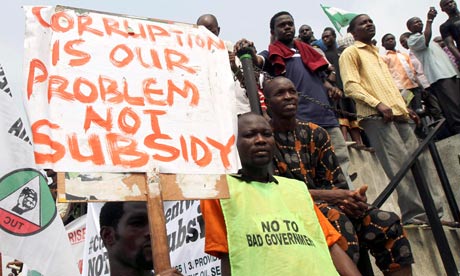
In Nigeria, there is a report in 2012 of how $35 billion oil revenue was lost.
"A top Nigerian anti-corruption crusader was asked to prepare a no-holds-barred report on the rotten state of country’s oil industry. He delivered. Nigerians now have a clear idea of just how much their government has squandered on inefficiency, mismanagement and personal bank accounts, and they’re not happy."
 The Guardian reported:
"The most damaging allegation involved the state oil firm and oil companies Shell, Total and Eni, which together owned a subsidiary company called Nigeria LNG. This company acted as a middle man, buying oil on the cheap from the government and selling it on to international markets at a vastly inflated price. Ribadu's report estimates that if the government had just sold the oil at market price, they would have made an additional $29-billion."
There are international conferences dedicated to this global problem.

One example.

Citizens Against Corruption in Natural Resource Management, a 2008 workshop by IACC, International anti-corruption conference.
Summary
The exploitation of mineral deposits and oil both offer huge scope for corruption. This workshop explored practical ways to mobilize civil society organizations to fight corruption in the management of natural resources, drawing lessons from two case studies. The first case deals with the misappropriation of oil revenues in Azerbaijan while the second case addresses the situation where unscrupulous commercial operators bribe poorly paid local officials in Mongolia.
This quote is from the report from Azerbaijan:
While the government has the main responsibility to manage the country’s oil revenues wisely and to account for its actions to the general public, this will not happen without effective public oversight. Thus, civil society -- broadly defined to include the independent media, business associations, research institutes and active individuals as well as advocacy NGOs -- can and must play a key role in demanding good governance and government must be persuaded to accept this oversight. (From Vugar Bayramov, Anti-corruption Initiatives in Oil Sector in Azerbaijan: Do Civil Society Organizations Matter?)

Apr 30, 2014

A short-lived citizen ownership democracy in Mongolia

Mongolians enjoyed 2 short years (2010 and 2011) of citizen ownership democracy, where citizens got a direct share of their country's mineral money. It was not a huge windfall. Each citizen received a citizen dividend of only about US$200 a year. It was a significant amount in Mongolia, where the average monthly household expense was about US$500.

Since the citizen dividend was not well protected in law, changing political parties easily changed the laws. The citizen dividend could even be stopped without changing any laws.

The current party in power, the Democratic Party under Prime Minister Altankhuyag, "discard the social welfare policy of universal cash handouts to citizens."

Only a few years back, under a different political party, Mongolia started a citizen ownership democracy:
Independent Mongolian Metals & Mining Research: Law on Human Development Fund. Monglia's sovereign wealth fund to pool in all revenues from mineral resources including OT and TT has been approved: (2009)

Parliament Speaker D.Demberel said :
“ Just now Parliament approved very important law. This is not about simply distributing money to citizens. This has created legal environment that decided to have citizens receive a share from revenues gained from minerals.
Citizen ownership democracy has died in Mongolia.

This death need not be permanent.

The Mongolia experience underlines the importance of protecting the citizen dividend through a "referendum" law so that politicians cannot confiscate it easily. This is what the Alaskans are trying to do: to protect their citizen dividend in their Constitution, which will require a referendum to change.

Jul 26, 2013

UBI for Brazil: The answer to Pope Francis' call

Pope sends message of hope to Brazil's poor.
Pope Francis tells slum dwellers of Manguinhos that world's rich must do much more to wipe out vast inequalities.
"No one can remain insensitive to the inequalities that persist in the world," he said.
Brazilians can help themselves by reactivating their universal basic income. UBI.

Brazil passed an unconditional basic income law in 2004 but until today has not begun any unconditional basic income distribution. In contrast to the slow progress in Brazil, Mongolia passed their citizen ownership dividend law in 2009 (Human Development Fund) and has been paying citizen dividend since then.

"In Brazil, President Lula´s law 10,835 from 2004 says that “A monthly benefit enough for the basic needs of a person will be paid equally to all.  This basic income is to be instated by steps, taking care first of the most in need.” This law is still unregulated but the government, immediately after, created the successful Bolsa Familia (BF) program. Law 10,835 is unique in the world and needs to be regulated as to the steps to be taken to gradually universalize the benefit." OPINION: A Three-Step Proposal to Get to a Basic Income For All Brazilians | Basic Income News (2013, binews.org)
"No progress has been made toward implementing a basic income since then." (Citizens for Public Justice, 2009)
"The poor were in fact supported by the Bolsa Familia program but the universal and unconditional part was left to anyone’s suggestion. We are supporting the idea to start the universal and unconditional basic income with all newborns in Brazil, starting in the near future." (by Francisco G. Nobrega, from  Basicincome.be, 2013)


Jul 1, 2013

The long road to a citizen-ownership democracy

"There is a typical problem in the xxx culture. When some one got the power it start to behave like a king and abuses the power it got. 
This what happend to President xxxx that won the elections but tried to push radical xxxxx spirits that not comply with many of the people."
A quote from the Internet 
The frustration from a democratic dictator is common to many cultures and countries.

It takes special leaders and special situations for a democracy to take roots. And it takes even more special leaders and special situations for a citizen-ownership democracy to begin.

So far in human history, there are only two cases where citizens are legally recognized as owners of their country with a right to citizen income from the country's wealth.. One is Alaska in early 1980s. The other is Mongolia in 2009.

Jun 12, 2013

Luvsanvandan Bold. A Mongolian Member of Parliament to watch.

Luvsanvandan Bold
Member of Parliament, Mongolia
According to this page at the Community of Democracies,
As a member of the State Great Khural, L.Bold initiated a draft law on Bayanmongol Corporation which has served as the basis for the law on Human Development Fund passed later by the Parliament.
The law on Human Development Fund is a very important law in the evolution of democracy. It is a law that recognizes citizen ownership of common properties and the distribution of citizen ownership dividend. The law was passed in 2009.
http://cod-democracy.blogspot.sg/2013/06/mongolia-yearly-cash-for-citizens-human.html
Parliament Speaker D.Demberel said :“ Just now Parliament approved very important law. This is not about simply distributing money to citizens. This has created legal environment that decided to have citizens receive a share from revenues gained from minerals.
Bold also proposes setting up an independent national company that holds common wealth and distributes dividends to citizens. It is similar to the Alaska Permanent Fund, which is also independent from the government.

Jun 6, 2013

Mongolia: Yearly Cash for Citizens. Human Development Fund.

Mongolia is a citizen-ownership democracy!
It has laws that recognize citizen rights to the country's common wealth and it distributes citizen dividends annually/monthly.
Mongolia is a big country with a small population.
Population: 3.2 million (2013 estimate)
Country area: 1,564,116 sq km.
In comparison Malaysia has 10 times the population and one-fifth the country area, and
Singapore has 5.5 million population and an area of 700 sq km.

In 2009, Mongolia started the Human Development Fund that distributes cash dividend annually to its people.

Here are a few details about the Human Development Fund, from this paper: Managing Mongolia’s resource boom, by Asel Isakova, Alexander Plekhanov and Jeromin Zettelmeyer.
By law, the Human Development Fund is financed from mining dividends pertaining to the state and an (unspecified) part of royalty payments to the budget. The funds can be used for cash handouts to all citizens, as well as for payments linked to pensions, health care, education and housing. The law does not contain explicit provisions determining the size of payments from the Fund. The revenues and expenditures of the Fund are approved annually as part of the general budget process. 
In addition, Article 8 of the law contains a somewhat vague indication that every Mongolian may hold non-tradable preference shares in a state-owned legal entity, which holds strategic mining licences. The law leaves open to interpretation the exact relationship between such a holding and the Human Development Fund.
In February 2010 every citizen received a cash handout of MNT 70,000 (equivalent to about US$ 50), followed by smaller instalments totalling another MNT 50,000 in that year. Earlier public promises were made by key political parties to make total cash transfers of MNT 1.5 million per capita (US$ 1,200). In 2011 monthly cash handouts were sustained at MNT 21,000 (around US$ 15), and approximately a quarter of this amount was additionally disbursed as tuition fee support, leading to projected annual spending of around US$580 million (almost 10 per cent of 2010 GDP).
Mongolia recognizes citizen ownership dividend. It is a giant step toward a citizen ownership democracy. Legal recognition of citizen rights to the country's common wealth is a very significant step. Most countries only give lip service.

Independent Mongolian Metals & Mining Research: Law on Human Development Fund. Monglia's sovereign wealth fund to pool in all revenues from mineral resources including OT and TT has been approved: (2009)
Parliament Speaker D.Demberel said :
“ Just now Parliament approved very important law. This is not about simply distributing money to citizens. This has created legal environment that decided to have citizens receive a share from revenues gained from minerals.
It appears that although cash distribution is written into their laws, the amount is determined by politicians every year. This does not bode well for citizens, as we have seen in the case of Alberta's Heritage Fund. Politicians usually prioritize spending over citizen dividend distribution. The protection for a citizen dividend is not as strong as the Alaska Permanent Fund. 

Jun 5, 2013

Spend or Send. Mongolia is a citizen ownership democracy!

Spend or Send - Finance & Development, December 2012: by Rabah Arezki, Arnaud Dupuy, and Alan Gelb


Mongolia distributes part of its mining revenues to its citizens and has recently pledged to endow each Mongolian with a portfolio of dividend-yielding preference mining shares.

Mongolia is a citizen-ownership democracy. Not a full citizen-ownership democracy, but a partial one. Alaska is also a partial citizen-ownership democracy.

Sep 30, 2011

Citizen-ownership Democracy. Partial Examples. Canada. Mongolia. Russia

A) Canada, Alberta.

"In late 2005, Alberta Premier Ralph Klein announced that one-third of the Canadian province's unbudgeted surplus from high oil revenue would be distributed to Albertans, each of whom would receive a CanS400 check in 2006." (From Oil, profits, and peace: does business have a role in peacemaking? By Jill Shankleman)

This is not as good as a full citizen-ownership democracy where the full oil revenue will be distributed directly and equally to all citizens.


B) Mongolia. Where citizens own the land of their country.

"Between May 2003 and May 2005, each Mongolian is officially afforded the opportunity to take up a private, household landholding within their respective “home” areas. The amount of land varies according to the latest land law, with the smallest parcels being granted in large urban areas, and larger parcels being granted in aimag and soum areas."

"Land privatization in urban areas (approximately 0.02% of total land – but figures vary) is free of payment. Only application fees are paid, and we encountered fee payments that were significantly different than government published rates for different elements of the application. After May 2005, acquisition of land will require payment. Title is only granted to households/families at present. Families in Ulaanbaatar are entitled to 0.07 ha, while in families in rural aimag centers and soum centers are granted up to 0.35 and 0.5 ha, respectively."

http://pdf.usaid.gov/pdf_docs/PNADE605.pdf


C) Russia. Distributing free land to 3-child families.

Russian President Dmitry Medvedev has a really really fantastic plan. He gives 3-child families free land. "Caring for the future generation is the most reliable, intelligent and noble investment," Medvedev said. There is something there for Singaporeans to learn.

If Singapore adopts a citizen-ownership democracy, every citizen stands to receive thousands of dollar a year from the sharing of common wealth (see the Singapore example). This is a sure way to really grow the Singapore future generation.

http://en.rian.ru/russia/20110616/164646607.html
Russian President Dmitry Medvedev has signed an amendment to the national Land Code to provide free land parcels to families with three or more children, the Kremlin said on Thursday.


"In line with the amendments to the Land Code, citizens with three or more children will be granted free parcels of land held in state and municipal property, including for the purpose of individual housing construction," the amendment said.
The measure is part of a wider government policy to provide broader support to families and reverse a severe population decline.
During his annual address to the nation in November, Medvedev outlined a range of proposals aimed at supporting families with many children.
"Caring for the future generation is the most reliable, intelligent and noble investment," Medvedev said.